What Makes a Home Look Cheap and How to Fix It
Your home can be fully decorated and still not look right, and that is exactly what confuses most people.
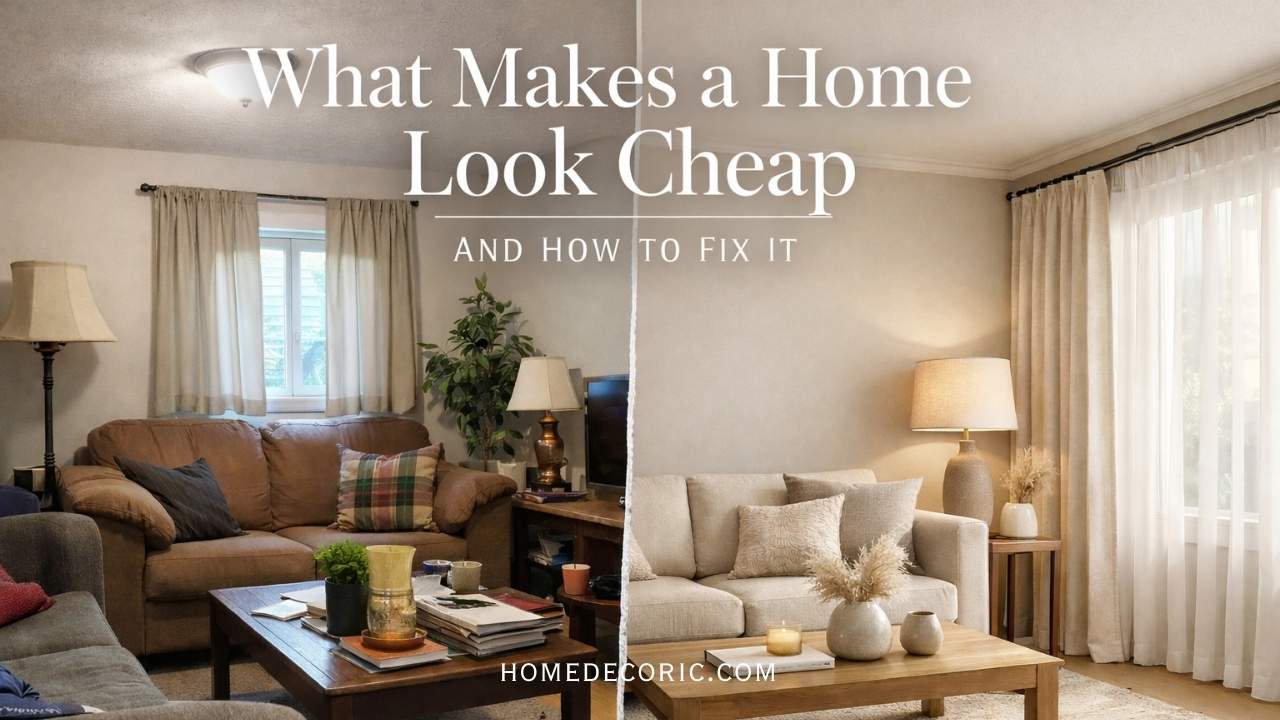
In this article, I break down one of the most common questions my audience asks: why a home can still look cheap even after decorating.
The good news is, it is usually not about the budget. It often comes down to a few easy-to-fix mistakes like poor scale, flat lighting, weak texture, and clutter, and I will explain each one so you can fix it step by step.
Fastest Ways to Make a Home Look More Expensive (Quick Answer)
The fastest ways to make a home look more expensive are to increase curtain size, add layered lighting, use better proportions, reduce clutter, upgrade builder-grade fixtures, and add real texture (linen, wood, wool, ceramic) rather than relying on shiny synthetic finishes.

Why Some Homes Look Cheap Even With a Big Budget
A home does not look expensive solely because of its price. It looks expensive when the room feels intentional.
People usually notice “cheap-looking” spaces when:
- furniture and decor feel randomly placed
- The curtains are too small
- lighting is flat or dim
- The materials look fake
- Everything is the same height or same texture
- Surfaces are crowded with decor
In short, the issue is often design decisions, not budget.
What Makes a Home Look Cheap
1) Poor Proportions
Poor proportions are one of the biggest reasons a room looks cheap. Common examples include curtains that are too narrow, rugs that are too small, or wall art that is undersized for the wall. When the scale is off, even good furniture can look wrong.
2) Fake-Looking Finishes
Some faux finishes immediately downgrade a room’s look, especially when they are shiny, repetitive, or overly patterned.
Examples include plasticky faux wood, unrealistic marble print, and glossy surfaces that imitate premium materials badly. These finishes look cheap because they lack natural variation or texture.
3) Flat Lighting
A single ceiling light (especially builder-grade fixtures) often makes a room look basic. Flat lighting removes depth, making materials look harsher and cheaper than they are. Good interiors usually use layered lighting rather than a single source.
4) No Texture or Visual Depth
Rooms made only of smooth synthetic materials can look sterile and one-dimensional. If everything is flat, shiny, and uniform, the room lacks warmth. Texture adds depth. Without it, the room looks unfinished.
5) Generic Decor and Clutter
Too many mass-produced decor items, or too many items in general, can make a room feel like a showroom or a storage zone. Crowded surfaces signal a lack of editing. A room looks elevated when the decor feels selected, not accumulated.
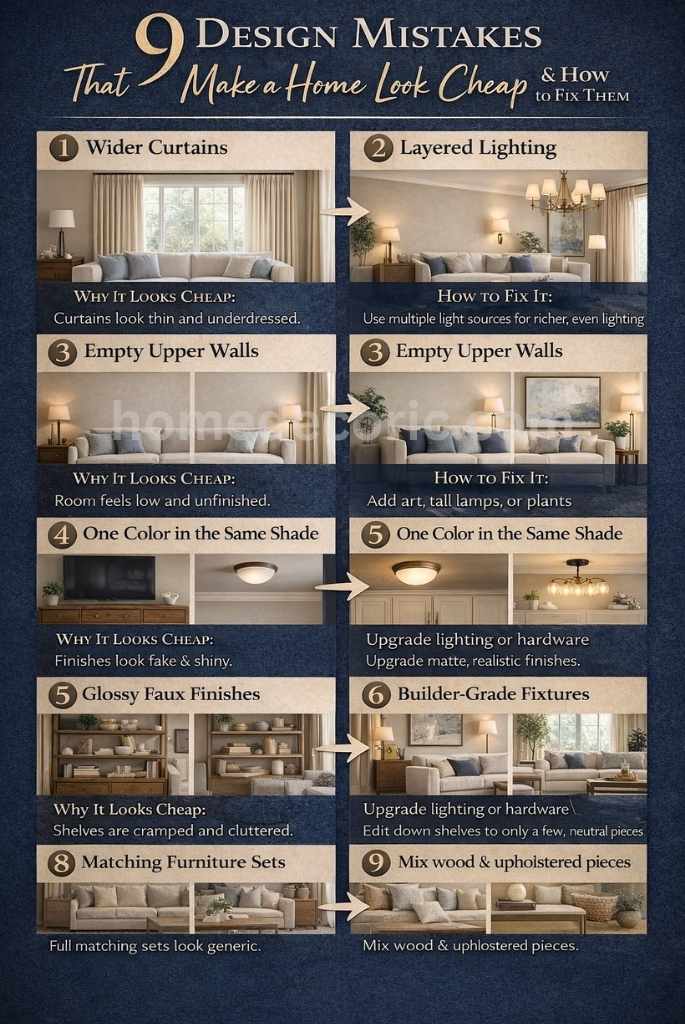
9 Design Mistakes That Make a Home Look Cheap and How to Fix Them
1) Curtains That Are Too Narrow
Why It Looks Cheap
Narrow curtain panels look thin and flat. They do not create proper folds, so the window looks underdressed.
How to Fix It
Use curtain panels with a total width of about 2 to 2.5 times the window width. This creates fullness and better visual weight.
Also, hang curtains high enough to draw the eye upward and improve the room’s proportions.
2) Empty Upper Walls and No Vertical Layering
Why It Looks Cheap
If everything sits low (sofa, coffee table, console) and the walls above are mostly empty, the room feels incomplete.
How to Fix It
Add vertical elements such as art, floor lamps, tall plants, sconces, shelving, and pendant lights. This balances the room and makes the space feel designed.
3) Repeating One Color in the Exact Same Shade
Why It Looks Cheap
Using a single “accent color” in the same tone throughout makes the room look flat and predictable.
How to Fix It
Use different tones and textures of the same color. For example, instead of repeating one green, mix sage, olive, and deep green with different finishes (linen, ceramic, painted wood). This creates depth without making the palette busy.
4) Obvious Faux Materials
Why It Looks Cheap
Fake-looking wood grain, printed foil veneer, and unrealistic faux marble patterns are easy to spot. They degrade the overall visual quality of the room.
How to Fix It
Choose more honest finishes:
- real wood veneer over printed foil
- matte surfaces over shiny plastic look
- simple stone-look finishes over dramatic fake patterns
You do not need luxury materials. You need believable materials.
5) Builder-Grade Light Fixtures and Hardware
Why It Looks Cheap
Default fixtures often look generic and fail to match the room’s style. Common examples include basic dome ceiling lights, plain mirrors, and standard shiny knobs.
How to Fix It
Make small swaps with high visual impact:
- change the ceiling fixture
- Replace cabinet knobs or pulls
- upgrade mirrors
- Add wall sconces or table lamps
These are often low-cost changes that immediately improve the room.
6) Only Using Smooth Synthetic Textures
Why It Looks Cheap
If a room has only polyester, plastic, MDF, and shiny finishes, it lacks depth and warmth.
How to Fix It
Add natural or textured materials such as:
- linen
- wool
- wood
- ceramic
- stone
- woven baskets
Texture makes a room feel more finished, even when the color palette is simple.
7) Overdecorating Shelves and Surfaces
Why It Looks Cheap
When every shelf and table is full, nothing stands out. The room feels cluttered and visually noisy.
How to Fix It
Edit down and style with fewer pieces. Keep only items that are useful, visually strong, and meaningful.
Use trays and baskets to group smaller items and keep the space organized.
8) Matching Furniture Sets Exactly
Why It Looks Cheap
Buying a full matching set can make a room look flat and showroom-like. It removes contrast and personality.
How to Fix It
Mix pieces while keeping a connection. Repeat a few common elements (wood tone, metal finish, shape, or color family) to make the room feel cohesive. This creates a designed look without being “matchy-matchy.”
9) No Cohesion Between Rooms
Why It Looks Cheap
When each room uses completely different colors, finishes, and styles with no link, the home can feel disconnected.
How to Fix It
Use a “red thread” across the home. Repeat subtle elements such as:
- one or two color families
- similar metal finishes
- related wood tones
- recurring shapes or textures
Cohesion makes the whole home feel more expensive.
How to Make Your Home Look More Expensive on a Budget
You do not need to renovate everything. Focus on the changes that improve visual quality the fastest.
Start with these high-impact fixes.
- Correct curtain width and height
- Upgrade one visible light fixture
- Add one lamp for layered lighting
- Remove clutter from major surfaces
- Replace cheap-looking hardware
- Add texture with pillows, throws, rugs, or baskets
- Improve the wall scale with correctly sized art or mirrors
These changes are more effective than buying random decor items.
The Elevated Home Formula
If you want a simple rule, use this:
Intention + Proportion + Texture + Editing = Elevated Look
- Intention means every piece has a reason to be there.
- Proportion means curtains, rugs, art, and furniture fit the space.
- Texture adds depth and warmth.
- Editing removes clutter so the best pieces stand out.
This is what makes a home look high-end, even on a modest budget.
Common Questions People Ask
How can I make my home look expensive without spending a lot?
Start with proportion and lighting. Use the correct curtain size, add layered lighting, reduce clutter, and use textured materials. These changes improve a room’s look more than buying lots of new decor.
What is the biggest thing that makes a house look cheap?
Poor proportions are among the biggest problems, especially with undersized curtains, rugs, and wall art. Fake-looking finishes and flat lighting also make a home look cheap quickly.
Do matching furniture sets make a room look cheap?
They can. Full matching sets often make a room look flat and less personal. Mixing pieces with a shared color or material usually looks more designed.
What materials make a room look more expensive?
Linen, wool, wood, ceramic, stone, and woven textures usually add depth and warmth. Matte and natural-looking finishes generally look better than shiny synthetic imitations.
Is clutter the reason my room looks cheap?
Clutter is a major factor. Even good furniture can look cheap in a crowded room. Clearing surfaces and editing decor often improves the room immediately.
Final Takeaway
If your home has been feeling “cheap” or unfinished, I want you to know it usually is not about how much money you spent. Most of the time, it comes down to a few specific things you can fix, like scale, clutter, texture, lighting, and the finishes you choose.
If you focus on those first, you can make your space look more polished, intentional, and expensive without a major budget.
Which one of these areas do you think is affecting your home the most right now?