
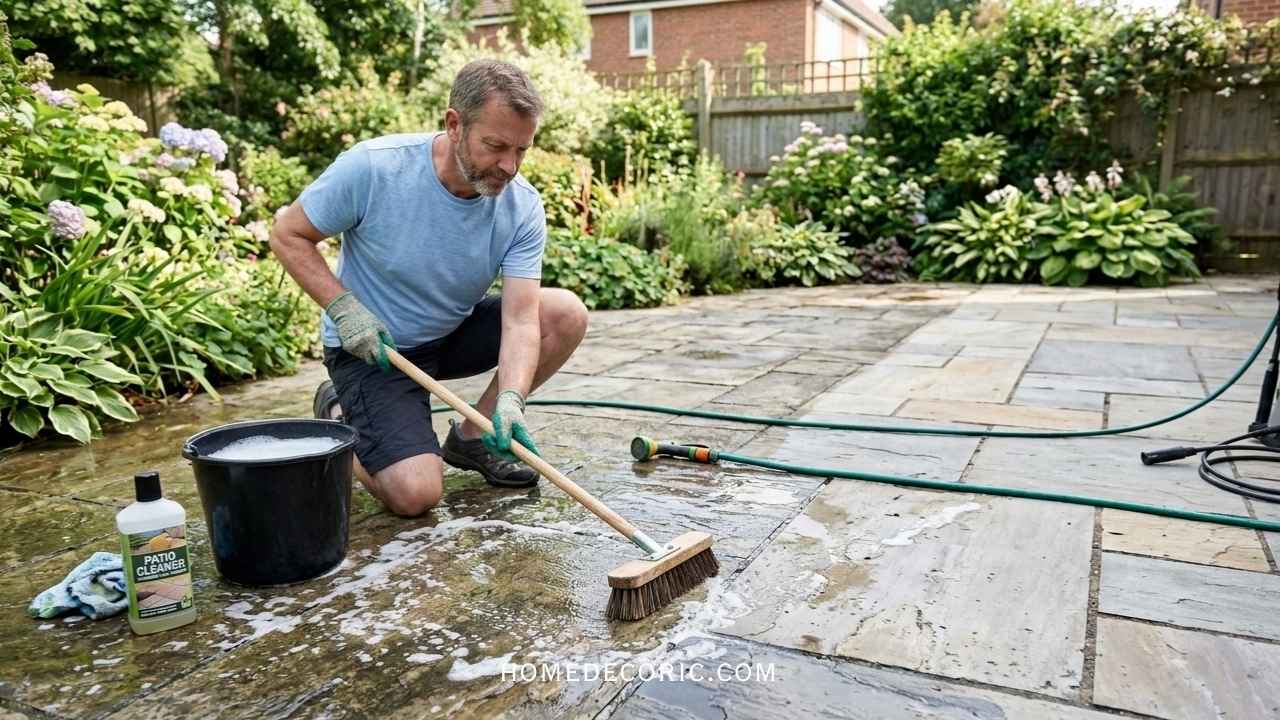
How Do I Clean Patio Tile?
Patio or outdoor kitchen tiles usually clean up fast, but if the joints are failing, the surface keeps looking dirty again. Loose joint sand gets pulled onto the tile face by rain, rinsing, sweeping, or pressure washing. That grit dries as a film, so the patio looks dusty even after you clean it.
Why Does The Dirt Keep Coming Back?
In many cases, it’s not stains in the tile. It’s a joint material breaking down.
If you can rub the joints with your finger and sand comes out easily, or you can see gaps forming, the joints are washing out. When that happens, every cleaning cycle spreads sand and dust across the tiles.
Two common reasons:
- Shallow joints: Many polymeric sands don’t hold well when joints are under about 1 inch deep.
- Incomplete curing: If polymeric sand didn’t fully set (wet too soon or not enough dry time), it can remain weak and wash out early.
How To Clean Patio Tiles Without Ruining The Joints
Sweep first while everything is dry. This prevents muddy residue from forming and spreading.
Wash the tile surface with water and a stiff brush.
If you use a pressure washer, avoid targeting the joints. Most washout happens when the spray is aimed directly along the joint lines or held too close in one spot.
Best Long-Term Fix: Re-Sand The Joints Properly
If you want the patio to stay clean, the joints need to stop shedding sand.
The durable approach is to remove the loose joint material completely and install new jointing sand correctly. That means blowing or vacuuming out the old loose sand, letting the patio become bone dry, sweeping new sand into every joint, and compacting it so it sits deep and tight.
After filling, the tile surface must be thoroughly cleaned to ensure no sand remains on the tiles. Then the area is activated with a light mist of water, allowing the binders to set and harden. Too much water can weaken the finish, so the “fine mist” part matters.
What Type Of Polymeric Sand Works Best For This Problem?
Polymeric sand can work, but it needs to match the joint depth and conditions. I noted that many polymeric sands, even high-end ones, can still wash out in shallow joints.
The recommended higher-performing options are designed to hold better in small or shallow joints, such as Alliance Nitro Sand, Romex Ecofine, or Techniseal Next Gel.
Romex Ecofine was mentioned as more resistant during maintenance, especially if you keep pressure washing under control and avoid blasting the joints.
What If My Polymeric Sand Is Still Failing?
If polymeric sand keeps washing out, the cause is usually installation or conditions, not just the brand.
Common issues include moisture in joints during installation, weak compaction, leaving sand on the tile surface, over-watering during activation, rain before full cure, or cleaning methods that hit the joints too hard.
Some people also avoid polymeric sand entirely because it can be unreliable under less-than-ideal conditions, especially in shallow joints or with frequent pressure washing.
The Practical Answer
Clean the tile surface gently, but treat the joints as the real source of the recurring mess. If the joints are stable and properly filled, the patio stays cleaner longer, and maintenance becomes simpler rather than repetitive.