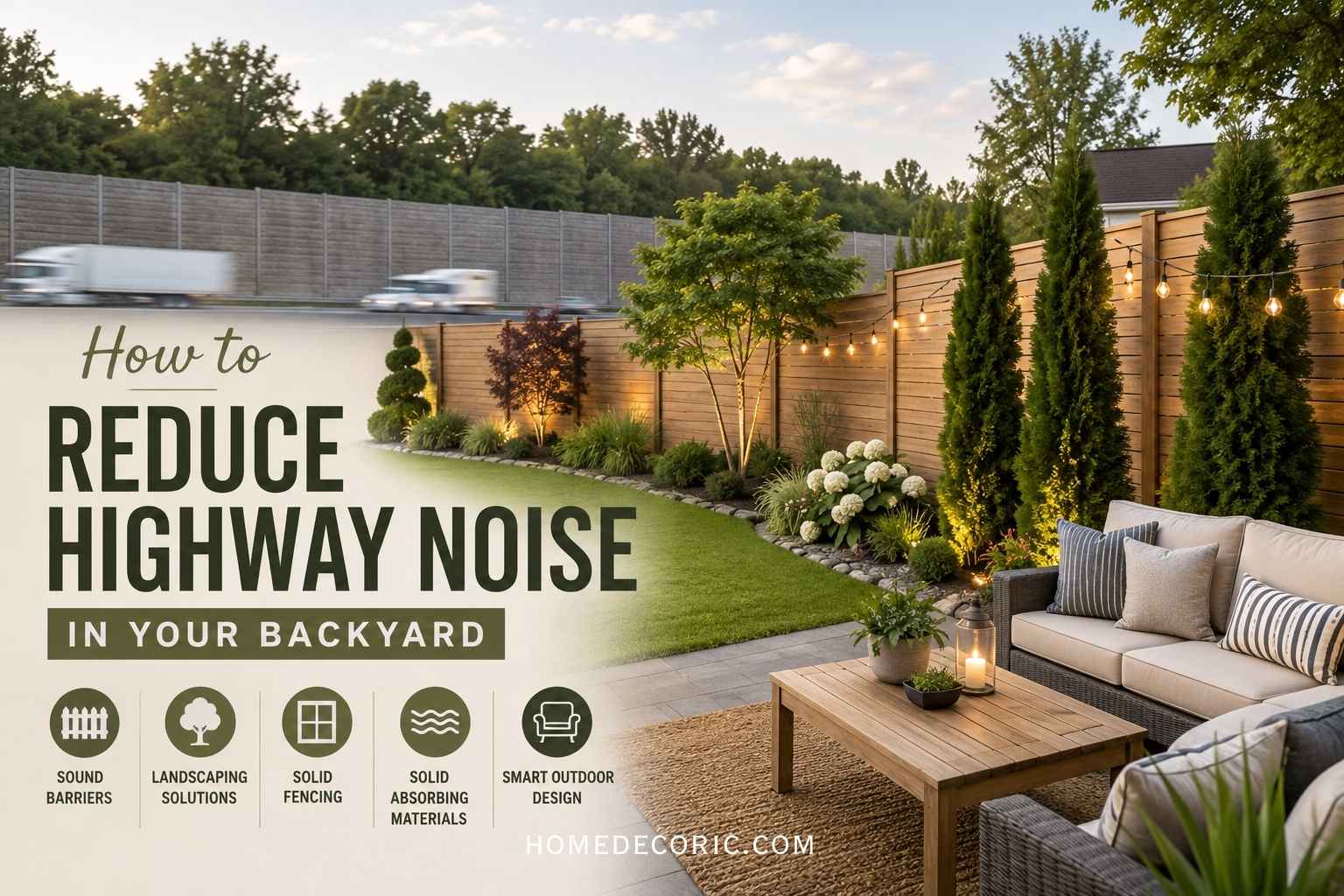
How to Reduce Highway Noise in Your Backyard: A Real Step-by-Step Guide
If your backyard backs up to a highway, you already know the sound never really stops. It is not just loud; it is that constant low rumble that makes it hard to relax outside, host a dinner, or even hear the person next to you.
I wanted a straight answer on what actually works, not just “plant some bushes and hope,” so I dug into what acoustic experts, landscapers, and homeowners who fixed this problem actually did.
Quick Answer
The most effective way to reduce highway noise in a backyard is to combine a solid, gapless barrier (fence or wall) near the noise source with dense, layered planting, and then add a water feature to mask any noise that gets through. No single fix eliminates highway noise, but combining two or three of these methods can dramatically reduce the perceived loudness.
Why Does Highway Noise Feel So Loud in a Backyard?
Traffic noise is mostly low-frequency sound, and low frequencies travel further and bend around small obstacles more easily than high-pitched sound.
If your yard has a clear line of sight to the road, sound waves are hitting your patio directly with almost nothing in the way to slow them down.
That is why a single row of shrubs rarely makes a noticeable difference on its own. It looks like a barrier, but sound moves right through and over it.
What Is the Fastest Way to Reduce Highway Noise?
A solid, continuous barrier is the single fastest fix. To actually block sound, a fence or wall needs to have:
- No gaps, slats, or lattice, sound leaks straight through any opening
- Enough height to break the direct line of sight to the highway (a good rule of thumb is that the barrier should block your view of the traffic from a seated position)
- Massive, denser materials like solid wood, vinyl-over-block, brick, or masonry outperform thin panels.
If you are picking materials and styles, our garden fence ideas roundup features solid, gap-free designs that double as noise barriers rather than purely decorative ones.
Do Distance and Height Matter More Than Material?
Yes, actually. Acoustic research consistently shows that the placement of a barrier matters as much as what it is made of.
A barrier placed close to the noise source (near the property line facing the highway) blocks more sound than the same barrier placed close to your house.
And every extra foot of height helps more than extra thickness once you already have a solid material. If your yard slopes toward the road, that works against you, since it gives the highway a clearer path to your patio.
Can Grading or a Berm Help Block Highway Noise?
A berm, essentially a mound of earth, is one of the most underrated noise solutions because it adds both height and mass without needing a tall structure. Combined with a fence on top, a berm can outperform a fence alone.
Before building one, you will want your yard properly graded so that water drains away from your house rather than pooling behind the mound.
Our step-by-step guide to leveling a backyard walks through the grading basics you will need before adding any raised landscaping feature.
Do Plants and Trees Actually Reduce Highway Noise?
On their own, no, not much. But planting is not really about blocking sound; it is about absorbing it and breaking up the “visual” connection to the highway, which lowers how loud the noise feels even when the decibel reading barely changes. For real impact, plantings need to be:
- Dense and layered, combining evergreen trees, tall shrubs, and low ground cover so there are no gaps at any height
- At least 10 to 15 feet deep, a thin single row does very little
- Evergreen, so you are not losing your buffer every winter
If your lot is small and you cannot fit a deep planting buffer, layering matters even more since you have less room to work with.
Our tiny garden ideas guide has smart ways to stack plantings vertically in a limited footprint.
For a fuller, cottage-style buffer that still looks intentional rather than like a wall of shrubs, the rustic garden decor ideas post has layouts.
Do Water Fountains Really Help With Traffic Noise?
Yes, and this is the trick most people skip. A fence and plants reduce how much noise reaches you, but a water feature works differently: it adds a pleasant, steady sound that your brain focuses on instead of the traffic rumble.
This is called sound masking, and it is genuinely effective, especially on a patio or seating area close to the house.
Placement matters: put the fountain between your seating area and the highway side of the yard, not tucked in a far corner, so it sits between your ears and the noise.
We put together 23 DIY fountain ideas that range from simple tabletop builds to larger stacked-stone features, most of which can be built in a weekend.
How Do I Layer These Solutions for the Best Results?
Think of it as three layers working together, not one silver bullet:
- Block it — a solid, gapless fence or wall as close to the highway side of your property as your setback allows
- Absorb it — a deep, evergreen planting buffer in front of or behind that barrier
- Mask it — a water feature near your main seating area to cover whatever noise still gets through
Homeowners who combine all three typically report the biggest difference, far more than any single fix alone. Once the noise is under control, it is worth investing in the rest of the space, since you will actually want to spend time out there.
Our backyard decor ideas for summer nights and our outdoor lighting guide are good next steps once the noise problem is resolved.
Frequently Asked Questions
How many decibels can a fence reduce highway noise by?
A well-built solid fence with no gaps typically reduces perceived noise by 5 to 10 decibels, which translates to sound that feels roughly half as loud when it fully blocks the line of sight to the road.
How tall does a fence need to be to block highway noise?
It needs to be tall enough that you cannot see the traffic while seated in your main outdoor living area. For most yards, this means 6 to 8 feet, taller if the road is elevated relative to your property.
Do sound-absorbing panels work outdoors?
Yes, but they need to be rated for outdoor use and are usually reserved for situations with very limited space, since a planted buffer or berm is cheaper and more durable for most backyards.
How long do plants actually take to reduce noise?
Fast-growing evergreens can start providing a noticeable buffer within 2 to 3 years, though a fence or berm gives you an immediate result while the planting fills in.
Ready to Reclaim Your Backyard?
A noisy backyard does not have to stay that way. Start with one layer, a fence, a berm, or a fountain, and build from there.
For more real, tested backyard ideas like this one, browse the rest of the Home Decoric garden and outdoor decor collection, or subscribe to get new guides delivered straight to your inbox.