
How Many Christmas Lights Do You Need for Your Christmas Tree?
It really comes down to the tree you’re decorating. A tall, narrow tree needs fewer lights than a wide, full one. Bulb spacing, branch density, and whether you want a soft, subtle glow or a brighter, more festive look also make a difference.
My recommendation: Start with approximately 75–100 mini lights per foot of tree height for balanced coverage. You can always add a little more if you love a fuller, brighter Christmas glow.
How Many Christmas Lights Do You Need for Different Tree Heights?
The number of Christmas lights you need depends mainly on your tree’s height and the look you want.
A common decorating guideline is about 100 mini lights per vertical foot, although recommendations vary. Some suggest fewer lights for a softer appearance, while others recommend more for densely decorated trees.
| Christmas Tree Height | Balanced Lighting | Fuller Lighting |
|---|---|---|
| 4 feet | 300–400 lights | 400–600 lights |
| 5 feet | 375–500 lights | 500–750 lights |
| 6 feet | 450–600 lights | 600–900 lights |
| 7 feet | 525–700 lights | 700–1,050 lights |
| 8 feet | 600–800 lights | 800–1,200 lights |
| 9 feet | 675–900 lights | 900–1,350 lights |
| 10 feet | 750–1,000 lights | 1,000–1,500 lights |
These are approximate planning ranges for conventional mini lights, not manufacturer specifications. Larger bulbs, cluster lights, and different wrapping methods can change the required quantity.
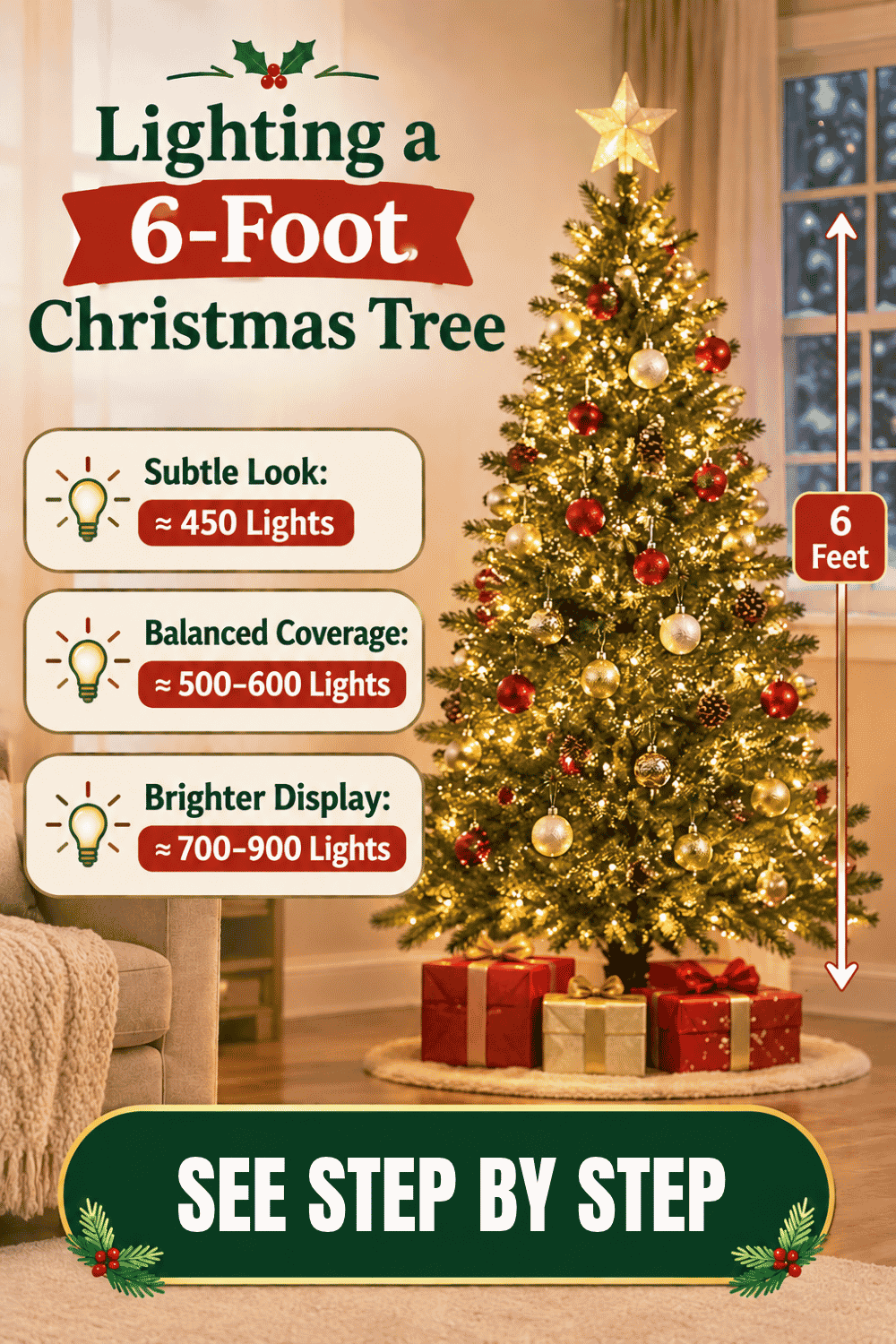
Example: Lighting a 6-Foot Christmas Tree
Suppose you have a 6-foot artificial Christmas tree in your living room.
- For a subtle appearance, start around 450 lights.
- For balanced coverage, consider approximately 500–600 lights.
- For a brighter display, consider approximately 700–900 lights.
If your tree has wide, dense branches, the higher end may work better. If it is slim or already decorated with plenty of ornaments, fewer lights may be sufficient.
For a typical 6-foot artificial tree, approximately 600 mini LED lights are a reasonable starting point.
Does Your Christmas Tree’s Width Affect How Many Lights You Need?
Yes. Tree width matters because two trees of equal height can have very different numbers of visible branches.
A full artificial tree usually has more branches and a wider silhouette than a slim or pencil-style tree. It may therefore need more lights to look similar.
Full Christmas Trees
Full trees have broad lower branches and a dense appearance.
They generally need more lights because there is more branch area to illuminate. If you want the lights to be visible throughout the tree rather than just around its edges, use a higher estimate.
Slim Christmas Trees
Slim trees have a narrower profile and take up less floor space.
They are a practical option for apartments, smaller living rooms, and corners. You can usually start below the standard estimate for a full tree of the same height.
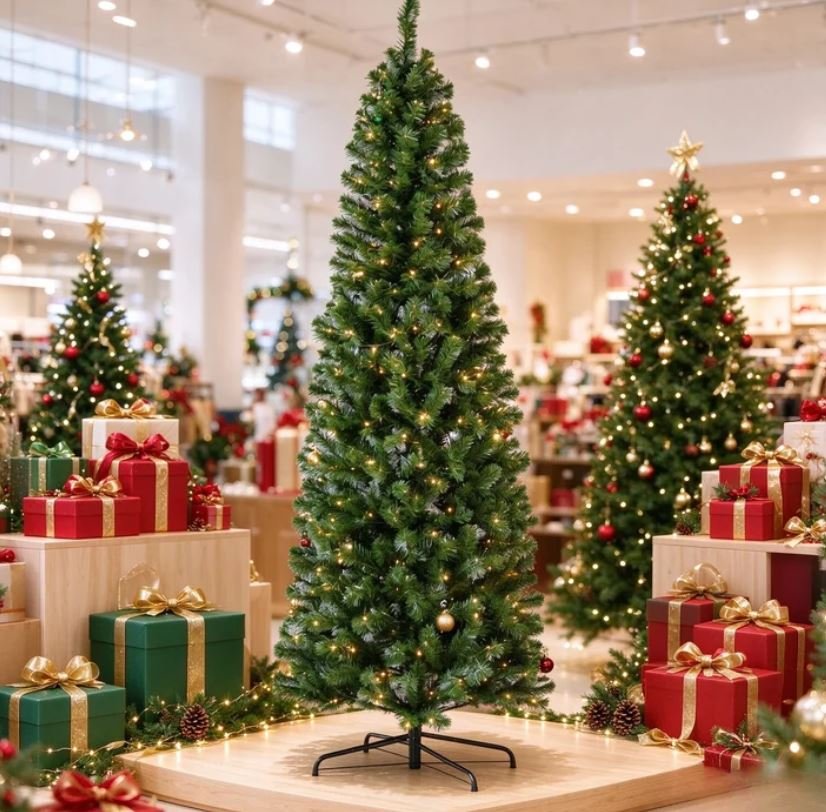
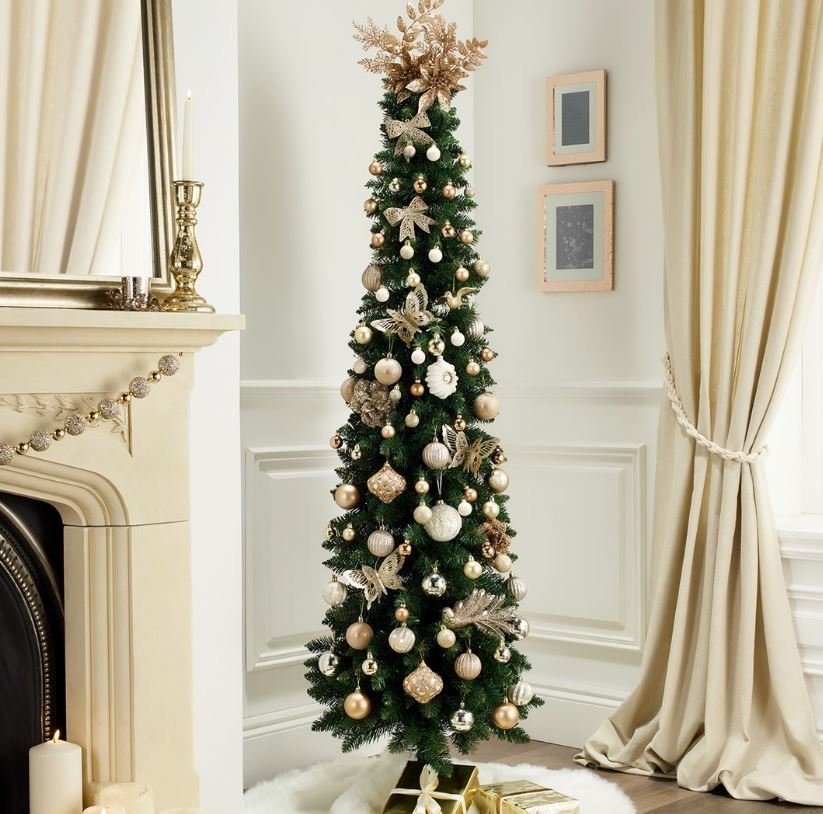
Pencil Christmas Trees
Pencil trees are particularly narrow and have a tall, vertical appearance.
They require less lighting material than broad trees when decorated with a similar surface-level effect. However, if you want to wrap lights deeply around the branches, you may still need extra string.
Do not buy lights based on height alone. Check the widest part of your tree and consider how far into the branches you want the lights to reach.
How Does Branch Density Change the Number of Christmas Lights?
Branch density determines how much of the tree’s interior and exterior needs illumination.
A densely branched tree can hide lights placed only around its outer edges. A less dense tree may look bright with considerably fewer bulbs.
Here is how you can adjust your lighting:
- Sparse branches: Use fewer lights and distribute them along the visible branches. Avoid concentrating all the bulbs near the trunk.
- Medium-density branches: Use a balanced quantity and spread the lights between inner and outer branches.
- Dense branches: Add more lights and work deeper into the tree so the interior doesn’t look dark.
One detail worth considering before buying is whether your tree already has built-in lighting. If it is pre-lit, count its existing bulbs and turn them on before deciding whether you need additional strands.
Adding too many lights to a pre-lit tree can make the result unnecessarily bright and leave less room for ornaments.
LED vs. Incandescent Christmas Lights: Which Should You Choose?
LED and incandescent Christmas lights can both decorate a tree beautifully, but they differ in key ways.
For most households buying new Christmas lights, LED lights are a practical choice because they generally use less electricity and produce less heat than traditional incandescent bulbs.
| Feature | LED Christmas Lights | Incandescent Christmas Lights |
|---|---|---|
| Electricity use | Generally lower | Generally higher |
| Heat production | Generally lower | Generally higher |
| Appearance | Warm, cool, and multi-color options | Familiar traditional glow |
| Lifespan | Generally longer | Generally shorter |
| Initial cost | Often higher | Often lower |
| Best for | Energy-conscious decorating | Traditional lighting preferences |
Why Are LED Lights a Practical Choice?
LED lights produce light using light-emitting diodes rather than heated filaments.
This makes them more energy-efficient than traditional incandescent lights. They also generally produce less heat, which helps when decorating a tree with many ornaments and accessories.
However, LED does not automatically mean risk-free. Damaged wires, unsuitable electrical connections, and incorrect product use can still create hazards.
Are Incandescent Christmas Lights Still Worth Buying?
Incandescent lights can be a good choice if you particularly like their traditional appearance.
Some people prefer their familiar warm glow, especially when decorating vintage-style Christmas trees.
However, they generally consume more electricity and produce more heat. If you choose them, pay particular attention to the manufacturer’s instructions and electrical ratings.
For most new purchases, warm-white LED mini lights offer a practical mix of a traditional look and lower electricity use.
Does Light Count or String Length Matter More?
Both matter, but they tell you different things.
Light count tells you how many individual bulbs are included. String length tells you how much physical distance the wire covers.
Two Christmas light strings can contain 100 bulbs each but have different lengths because their bulbs are spaced differently.
For example:
- String A: 100 bulbs spaced approximately 4 inches apart.
- String B: 100 bulbs spaced approximately 8 inches apart.
String B covers approximately twice as much distance between its first and last bulbs.
You can estimate the illuminated section of a light string using this simple calculation:
Lit length = (Bulb count − 1) × Bulb spacing
For example, 100 bulbs spaced 4 inches apart cover approximately 396 inches, or 33 feet, between the first and last bulbs.
| Number of Bulbs | Spacing | Approximate Lit Length |
|---|---|---|
| 100 | 4 inches | 33 feet |
| 100 | 6 inches | 49.5 feet |
| 100 | 8 inches | 66 feet |
| 200 | 4 inches | 66 feet |
| 200 | 6 inches | 99.5 feet |
These figures exclude unlit lead wire between the plug and first bulb, and any additional tail wire.
What Should You Check on the Packaging?
Before purchasing, look for:
- Total number of bulbs or LEDs.
- Total illuminated string length.
- Distance between individual bulbs.
- Indoor or outdoor suitability.
- Electrical voltage and wattage.
- Whether multiple sets can be connected end to end.
- Any included transformer or power adapter requirements.
For a tree with lots of branches, closer bulb spacing can help produce more consistent illumination.
Do not assume that a 200-light package will always cover twice as much tree as a 100-light package. Bulb spacing and wrapping technique make a difference.
How Do You Distribute Christmas Lights Evenly on a Tree?
Buying the correct number of lights is only part of the job. Their placement determines whether the finished tree looks balanced or has bright spots and dark patches.
For a natural-looking result, distribute the lights from the inside branches toward the outer tips instead of wrapping every strand around the outside of the tree.
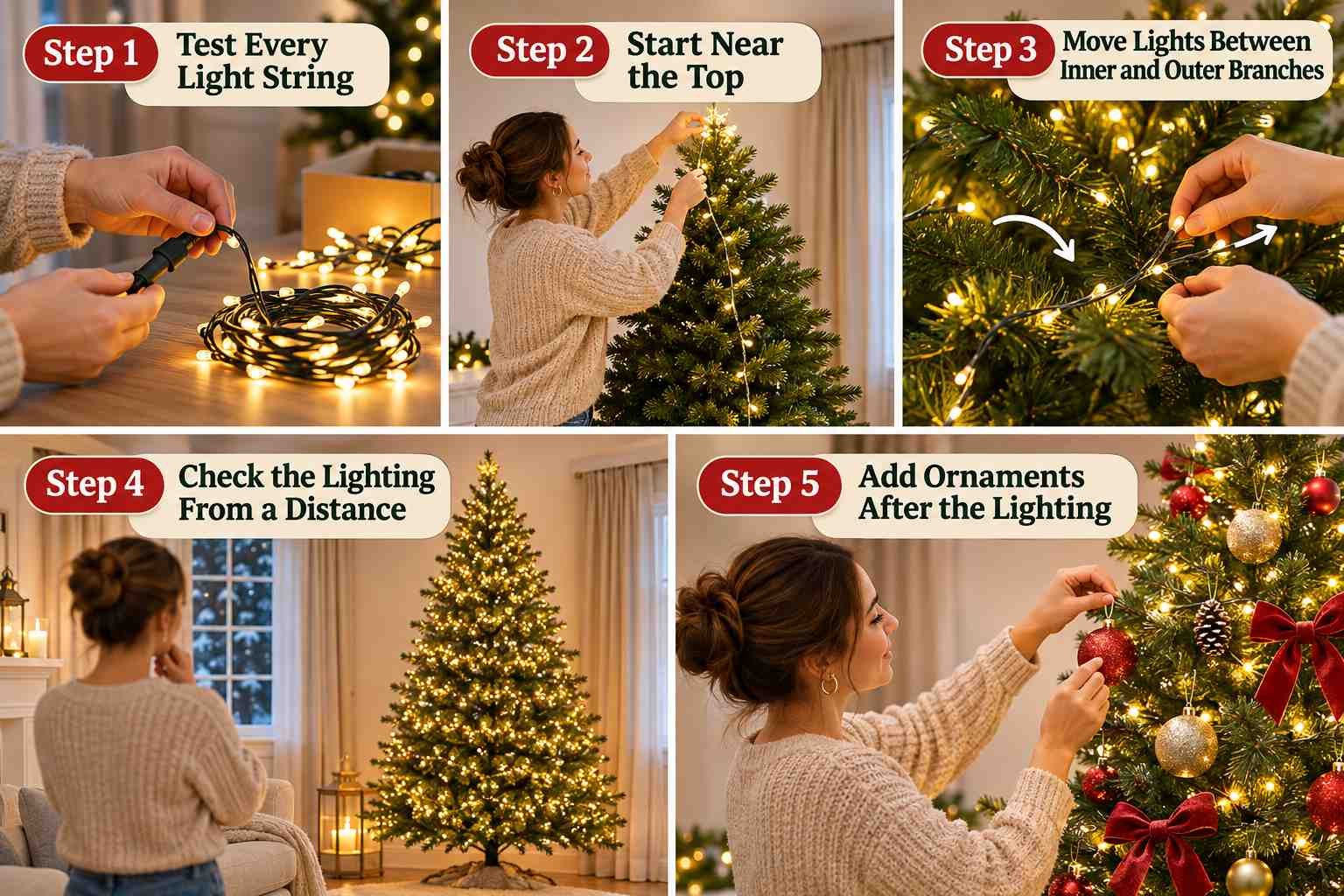
Step 1: Test Every Light String
Before placing anything on the tree, plug in each light string and check that it works.
Look for missing or flickering bulbs, damaged insulation, loose connections, cracked sockets, and frayed wires.
Replace damaged strings instead of hiding them inside the branches.
Step 2: Start Near the Top
Position the first strand near the top of the tree, keeping its connection and power lead accessible.
Work downward gradually, following the natural shape of the branches.
If the power outlet is near the bottom, plan the route so that the plug and lead can reach it without stretching or creating a trip hazard.
Step 3: Move Lights Between Inner and Outer Branches
Avoid placing all the lights along the outer tips.
Instead:
- Move the wire toward the trunk.
- Bring it outward along a branch.
- Place some bulbs deeper inside the foliage.
- Continue toward the branch tips.
- Repeat the pattern as you work around the tree.
This creates depth and helps illuminate more of the tree’s shape.
Step 4: Check the Lighting From a Distance
After decorating a section, step back and view the tree from your usual spot.
Check whether one side looks brighter than the other, large dark patches remain, the lights are concentrated at the bottom, or some sections have too many visible wires.
Adjust the spacing before adding more decorations.
Step 5: Add Ornaments After the Lighting
Once the lights are distributed, add your ornaments.
This makes it easier to see where the tree needs more illumination and prevents you from repeatedly moving fragile decorations.
If your tree is positioned against a wall, you do not necessarily need to decorate its hidden rear side as densely as the front. However, maintain a balanced appearance around the visible edges.
How Many Christmas Lights Do You Need for a Small Living Room?
A small living room doesn’t necessarily require fewer lights. The tree’s height, width, and placement matter more than the room’s overall size.
However, a very bright tree can dominate a small space, particularly when the room already has decorative lamps, illuminated garlands, or other Christmas accessories.
For a smaller living room:
- Consider a 4–6-foot tree if floor space is limited.
- Choose a slim tree if you need to preserve walking space.
- Start with balanced rather than dense lighting.
- Use warm-white LEDs for a softer appearance.
- Avoid excessive decorative lighting around the same area.
For example, a 5-foot pencil tree with approximately 350–400 mini lights may create an attractive display without making a small room feel visually crowded.
For a full 6-foot tree, approximately 500–600 mini lights may be a more suitable starting point.
These are styling recommendations, not strict requirements. Your tree’s width and the effect you prefer should guide the final quantity.
How Can You Avoid Overloading Christmas Light Connections?
Christmas lights are electrical products, so you should consider more than just the number of bulbs.
Connecting too many light strings or using unsuitable extension cords can create electrical hazards.
Before connecting multiple light strings, follow these precautions:
- Check the manufacturer’s maximum number of connectable strings.
- Do not exceed the specified wattage or current rating.
- Use compatible connectors and power adapters.
- Avoid connecting different products unless the manufacturer confirms compatibility.
- Do not overload outlets or power strips.
- Keep electrical connections away from water.
- Never use a damaged or frayed light string.
What Safety Labels Should You Look For?
For products sold in the United States, look for recognized independent testing marks such as UL or ETL, where applicable.
Check that the lighting set is intended for indoor tree decoration. Outdoor lights should carry the appropriate outdoor-use rating.
No universal rule says you can connect every Christmas light string to three or five other strings. The permitted number depends on the particular product and its manufacturer’s instructions.
Should You Turn Christmas Tree Lights Off Overnight?
Yes. Turn off and unplug your Christmas tree lights before bed or before leaving the house, following the manufacturer’s instructions.
A suitable timer can make it easier to manage the lighting schedule, but it should not replace safe electrical installation and regular inspection.
Common Mistakes to Avoid When Decorating a Christmas Tree With Lights
Even with the right number of lights, a few decorating mistakes can affect the final look.
1. Buying Lights Based Only on Tree Height
A 7-foot pencil tree and a 7-foot full tree do not have the same lighting requirements.
Better approach: Check the tree’s width and branch density before purchasing.
2. Ignoring Bulb Spacing
A package with 300 lights might sound sufficient, but widely spaced bulbs can leave noticeable gaps.
Better approach: Compare the bulb count and illuminated string length before buying.
3. Placing All Lights on the Outer Branches
This can make the tree look flat, with a bright exterior and dark interior.
Better approach: Distribute the lights between inner and outer branches.
4. Connecting Too Many Light Strings
Using more connections than the manufacturer permits can create electrical risks.
Better approach: Read the packaging and follow the maximum connection and electrical-load limits.
5. Adding Too Many Lights to an Already Decorated Tree
Too many lights can compete with ornaments and other decorative elements.
Better approach: Start with a balanced quantity, switch on the lights, and add another compatible string only if necessary.
6. Forgetting to Check the Lights Before Decorating
Finding a faulty string after placing hundreds of ornaments can make decorating unnecessarily frustrating.
Better approach: Test every string before installation and inspect the wires, sockets, and connections.
Frequently Asked Questions
How Many Christmas Lights Do I Need for a 6-Foot Tree?
For a 6-foot Christmas tree, approximately 450–600 mini lights are a reasonable starting point for balanced coverage. For a brighter look, consider about 600–900 lights. A wide, densely branched tree may require more than a narrow tree.
How Many Christmas Lights Do I Need for an 8-Foot Tree?
An 8-foot tree generally needs approximately 600–800 mini lights for balanced coverage. For a fuller display, consider 800–1,200 lights. Adjust the quantity according to the tree’s width and branch density.
Are 100 Lights Per Foot Enough for a Christmas Tree?
Yes, 100 mini lights per foot is a useful starting guideline for many Christmas trees. However, it is not a universal requirement. Slim trees may need fewer, while wide, densely branched trees may need more.
Are LED Christmas Lights Better Than Incandescent Lights?
LED Christmas lights are generally more energy-efficient and produce less heat than incandescent lights. Incandescent lights may appeal to people who prefer their traditional appearance. For most new purchases, LED lights are a practical option.
Should Christmas Lights Go Inside or Outside the Branches?
Ideally, distribute lights throughout the branches. Place some bulbs closer to the trunk and others toward the outer tips. This creates depth and helps prevent the tree from looking flat or unevenly illuminated.
Can I Connect Multiple Christmas Light Strings Together?
Some Christmas light strings are designed for end-to-end connections, but the permitted number varies by product. Check the manufacturer’s instructions, electrical ratings, and maximum connection limits before connecting multiple sets.
How Long Should Christmas Lights Stay On?
You don’t need to keep Christmas tree lights running continuously. Switch them off before sleeping or leaving home. A suitable timer can help manage their operating schedule, but always follow the product’s safety instructions.
Final Recommendation
If you are still unsure how many lights to purchase, start with your tree’s height, check its width, and decide how bright you want the finished display to look.
For a typical artificial Christmas tree, approximately 75–100 mini lights per foot is a reasonable starting range for balanced coverage. If you prefer a fuller appearance, consider approximately 100–150 per foot.
For most new purchases, warm-white LED mini lights are a practical choice because they generally use less electricity and produce less heat than incandescent alternatives.
Before placing your order, remember three things:
- Choose the quantity according to your tree’s actual shape.
- Check both bulb count and illuminated string length.
- Follow the manufacturer’s electrical and connection instructions.
The goal is not to cover every branch with as many lights as possible. It is to create an evenly illuminated tree that looks comfortable and proportionate in your home.